
How to Check Syracuse Warrants
Syracuse lists no town criminal court in the current Indiana Court Directory and runs no police warrant portal of its own. The practical Syracuse warrant search begins with Indiana MyCase, which opens public, nonconfidential case and docket data to anyone. Treat it as a case search, though, not a warrant list. If you hold a citation, case, or cross-reference number, enter it exactly. A name search can find the file, but a name match alone proves nothing until someone reads the docket. Work from the case toward the office that can confirm it. Even the words "Warrant issued" on a docket do not mean the order is active today. A blank search, in turn, is no all-clear for Syracuse.
- Search MyCase by case number, citation number, cross-reference number, or legal name.
- Read the public docket for issuance, failure to appear, recall, return, and later hearing entries.
- Call the Circuit or Superior Court division shown on the docket.
- Ask the Kosciusko County Clerk for a specific public docket record when online detail is missing.
- Use the Sheriff's non-emergency line for service, custody, or court-directed surrender routing.
Syracuse Has No Warrant Portal
The official Syracuse town site offers no town warrant search, no active-warrant roster, no most-wanted page, and no steady police warrant page. That gap matters. It pushes Syracuse residents toward third-party lists that may be stale, incomplete, or pulled from some other jurisdiction entirely. There is also no local update schedule, warrant-number field, or bond column to rely on. Confirmation has to come from the court record instead.
Do not treat silence as clearance. No result on a town page or in MyCase is not proof that a Syracuse warrant does not exist. Confirm the status with the court that owns the case.
The Sheriff's site posts no public criminal active-warrant roster either. Its general tip form is not a way to check on yourself. In Syracuse, warrant confirmation runs through a case record, the issuing court, the County Clerk, and the Sheriff, never one search box.
Syracuse Police and Court Roles
Syracuse police can investigate an incident, make an arrest, receive process, or help you find which agency handled a local event. A judge signs a judicial warrant. The Kosciusko County Clerk of the Circuit and Superior Courts keeps the court record. The Sheriff is the statutory recipient and serving agency named by Indiana's arrest-warrant law. Each office connects to the next, but none can do another's job. No Syracuse municipal court appears in the current Indiana Court Directory; the Kosciusko entries are Circuit Court and Superior Courts 1 through 4. So do not ask a town employee to recall a county warrant or hand out legal advice. That power sits with the issuing court.
Syracuse Town Routing
Clerk-Treasurer, 310 N Huntington Street, Syracuse, IN 46567
(574) 457-3216
Municipal administration and official town contact routing, not court-warrant confirmation.
Kosciusko Court Record
County Clerk and Circuit/Superior divisions, 121 N Lake Street, Warsaw
(574) 372-2334
Public court file, division identification, and records-request routing.
Syracuse Town and County Clerks
The Syracuse Clerk-Treasurer and the Kosciusko County Clerk keep entirely different records. A town clerk-treasurer handles municipal administration. The County Clerk, an elected official, is the custodian of Circuit and Superior Court case files. When a Syracuse warrant question grows out of a criminal, traffic, or failure-to-appear case, the County Clerk and the assigned court division hold the record.
- Town Clerk-Treasurer
- A Syracuse municipal official who can route town business but does not control county court warrants.
- County Clerk
- The custodian of Kosciusko Circuit and Superior Court dockets and public case records.
- Issuing court
- The court division whose judge entered the warrant and can take judicial action on it.
- Recall
- A court action withdrawing a warrant. A police or town records call does not create a recall.
When you call about a Syracuse case, ask something narrow. Give the case or citation number, the legal name, date of birth, and appearance date. Then ask which division owns the file and what its record shows.
Types of Syracuse Warrants
Syracuse residents can run into warrants tied to county criminal or traffic cases even when the event started inside town. Indiana sources tend to say "arrest warrant" and "failure to appear" rather than capias. Search warrants and tax warrants are separate records with different rules and purposes.
| Warrant Type | How It Arises | Issuing Authority |
|---|---|---|
| Arrest warrant | Charging grounds and probable cause meet Indiana law | Kosciusko Circuit or Superior Court judge |
| Bench or FTA warrant | A required hearing or court duty is missed | The county court handling the existing case |
| Traffic FTA warrant | A covered traffic summons is not answered | The assigned county court |
| Search warrant | A judge authorizes a search | Judicial officer under criminal rules |
| Tax warrant | A tax debt enters the separate revenue process | Tax system, not a criminal arrest court |
Juvenile warrant records are generally confidential. Federal warrants run through the Northern District of Indiana, not any Syracuse or Kosciusko public list.
Syracuse Warrant Court IDs
MyCase court codes show a Syracuse resident which division sits behind a docket. Kosciusko Circuit is 43C01. Superior Courts 1 through 4 use 43D01, 43D02, 43D03, and 43D04. Those prefixes steer the inquiry to the right court. They do not prove a warrant's current state. Local assignment rules add context: all misdemeanors go to Superior 2, IF infraction cases and traffic felonies go to Superior 3, and felonies split among Circuit and Superior divisions under more detailed rules. The docket still controls, because a short event description may hide the true case class.
Practical flow: Syracuse event › county case number and court ID › assigned judge and Clerk record › Sheriff service or custody route.
What Syracuse Warrant Records Show
With no public warrant-list schema in Kosciusko, Indiana law offers the safest picture of the fields. A written arrest warrant names the person or gives a reasonable description, states the offense, and carries the date and county. It bears the clerk or judge's signature, commands an arrest and prompt court presentation, states bail where applicable, and directs the warrant to the sheriff.
| Case number | The court file identifier, often carrying a Kosciusko court prefix such as 43D03. |
|---|---|
| Name or description | The person identified by the written warrant. |
| Offense | The nature of the alleged charge or the existing case obligation. |
| Issuing court | The Circuit or Superior division that controls judicial action. |
| Bail | An amount if applicable; no countywide Syracuse warrant schedule was found. |
| Status events | Docket terms such as issued, recalled, executed, returned, or a later hearing. |
MyCase may add dates, filings, and links to public documents. It may not show the warrant itself or its current execution status. Confirm both with the Syracuse-area court record.
Syracuse Traffic Warrant Routing
That APPEARANCE DATE printed on a Syracuse ticket starts the clock. Pay, deny, or comply by then under the county's traffic guidance. Miss it and the court can act. Indiana law permits an arrest warrant in covered misdemeanor or felony traffic cases after a failure to appear, and if the statutory process runs on without execution, the court can report that failure to BMV. So a Syracuse warrant check starts with the citation number in MyCase. Local rules assign IF infractions and traffic felonies to Superior 3, but the actual docket decides the division. Call with the citation, legal name, date of birth, and appearance date in hand. Ask whether the record shows an FTA, a warrant, a new date, a recall, a payment, or a motion requirement. A license suspension is not a warrant recall. Only the court can confirm warrant status, and the county publishes no verified online payment vendor or universal warrant-clearing fee, so an old payment link proves nothing about compliance.
Syracuse Warrants and Kosciusko County
Syracuse sits inside the Kosciusko court system, so a local police contact can sort out agency questions while the county does the judicial work. The Circuit and Superior Courts issue county warrants. The County Clerk keeps the docket. The Sheriff serves process and holds wanted persons, with a non-emergency line at (574) 267-5667. Indiana publishes no statewide public criminal-warrant repository.
Warrant flow: Syracuse police event › Kosciusko Circuit or Superior Court › County Clerk docket › Sheriff service or custody status.
The Kosciusko County warrant records overview walks through every county channel. For Syracuse, the short version: call the town to reach the right agency, but only the county court can confirm a warrant.
Call About Syracuse Warrants
Get your facts together before you dial a court about a Syracuse warrant. That means the legal name, date of birth, citation or case number, filing year, and the date of any missed appearance. Jot down the MyCase court ID and the exact event wording. With a common name, use the sounds-like option carefully and search All status when you are piecing together an older case. Once you reach a clerk, ask whether the warrant entry is still active and whether a recall or return has posted. Then ask what resolves it: an appearance, a motion, payment, proof of compliance, counsel filing, or a court-directed surrender. Clerks explain records and route calls. They cannot give legal advice. If the court sends you to law enforcement, use the official Sheriff's number, never a number from an unsolicited message, for any Syracuse warrant check.
- State that the inquiry concerns your own record or a relative's case.
- Give the docket identifier and court division.
- Ask for current status language, not a broad roster search.
- Confirm the next lawful step and how it will be documented.
Public Access to Syracuse Warrants
Syracuse warrant records kept in county court fall under Indiana court-access rules and the Indiana Access to Public Records Act. Many court records are presumed public, though the presumption has limits. Sealed files, investigatory material, juvenile records, and other excluded documents may be withheld or restricted. A request aimed at one record leaves a clearer trail than a blanket request for a list of private people.
Key Rules:
Indiana Access to Public Records Act, IC 5-14-3 provides the state framework for requests to public agencies and lawful exemptions.
Indiana Rules on Access to Court Records balance public access with sealed, confidential, privacy, and safety limits.
Indiana juvenile access law generally restricts juvenile court and law-enforcement records, including many warrant documents.
The Clerk's online form can request a specific public docket entry. It offers no warrant checkbox, set fee, or promised turnaround. A records request documents the record; it does not recall a Syracuse warrant.
Resolve Syracuse Warrant Records
Resolution starts once the court confirms the Syracuse warrant. Ask the assigned judge what the case needs. Depending on the facts, that could mean an appearance, a motion, action by counsel, payment, proof of compliance, a new hearing, or a court-directed surrender. Syracuse runs no amnesty program, no universal bond schedule, and no public surrender counter with warrant-window hours. Never show up unannounced on a guess. The court alone controls recall; the Sheriff handles enforcement after service or when the court directs surrender, and the Clerk keeps the file. Hold onto receipts, filed motions, docket printouts, and confirmation numbers. After the judge acts, recheck the docket and ask how the order reaches law enforcement. Anyone facing possible arrest should talk to a lawyer first, since a phone call promises nothing and payment alone may not cure a missed appearance. For immediate danger call 911. Routine Syracuse warrant routing belongs on official non-emergency and court channels.
Syracuse Warrant Town Source
The official Syracuse town route is the proper source for current municipal contact information.
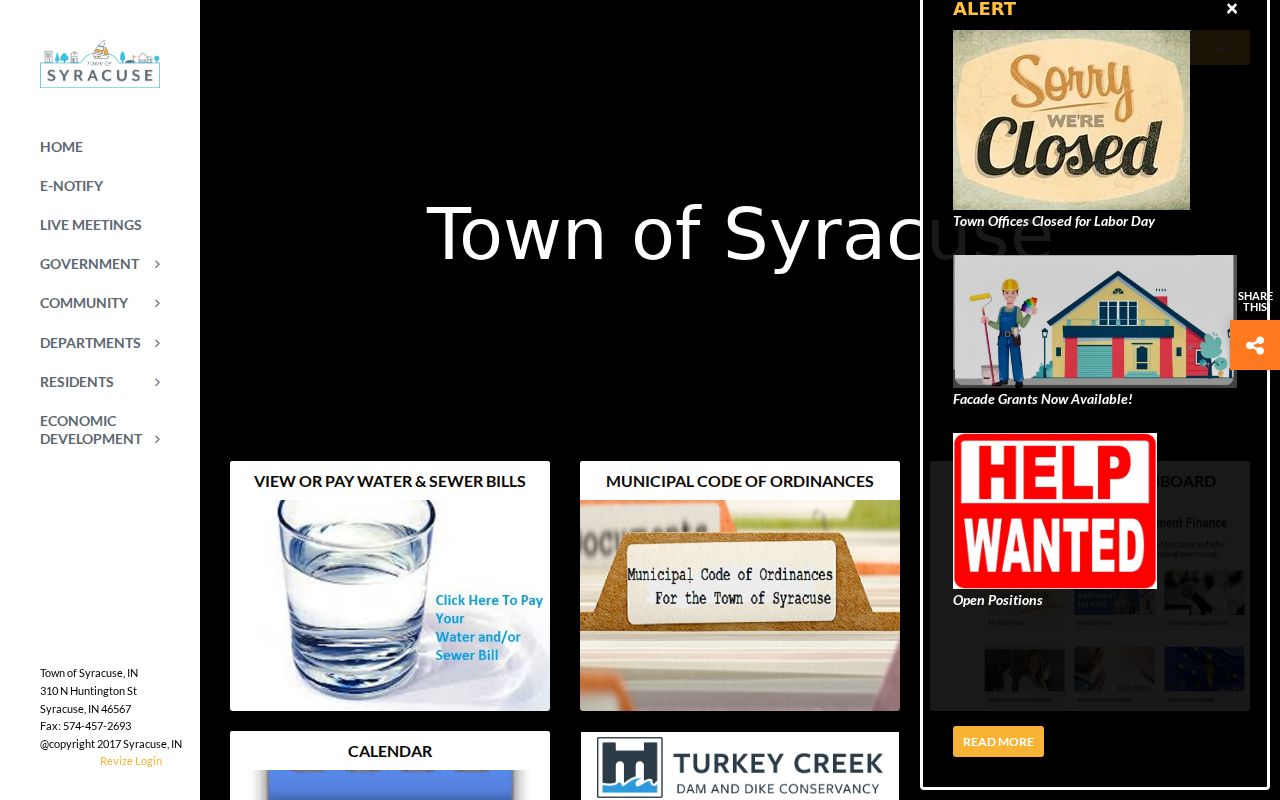
Use the official town view for agency routing. MyCase and the county court remain the sources for a Syracuse judicial warrant record.